New Project on the Study of International Law

In the United States, public international law is not an important part of legal education. By my count, only eight schools require their students to complete a course on the subject: Florida International, Harvard, Hofstra, UC-Irvine, Michigan, Nebraska, Washington, and Washington & Lee. Everywhere else, international law is purely elective. Insofar as relatively few students tend to choose this elective, we have a legal profession made up of individuals who lack formal training on topics like treaty interpretation, human rights law, and international organizations.

Is this common in other countries or another example of American exceptionalism? To answer that question, I conducted a global survey of the study of international law. The results, which are available in the form of an interactive world map at PILMap.org, show the frequency with which law schools and governments around the world require individuals to study public international law en route to obtaining a law degree. By clicking on individual states, you can look at summary statistics and details about the curricula of specific law schools.

To me, the results are fascinating for a variety of reasons. Here’s just one: The American tendency to relegate international law to a peripheral status in legal education is abnormal. It appears that all or nearly all law schools in a clear majority of countries teach a compulsory course on public international law. Unsurprisingly, this is true in Europe. But it is also true for much of Asia and all of Latin America, where it is not uncommon to see a curriculum with two or even three mandatory courses on topics such as international humanitarian law and human rights law.

The United States is not entirely alone. Almost no law schools in the United Kingdom, Ireland, or New Zealand require international legal training, and only minorities do in Australia and Canada. Similarly, compulsory courses on international law are virtually absent in the civil law jurisdictions of Japan and South Korea, perhaps due to the relatively close relationships that they share with the common law West. And finally, international legal education is essentially absent in a small number of unstable and impoverished states, such as the Central African Republic and South Sudan. There is a common law/ civil law divide. And there is a rich/ poor divide.

The map raises a lot of interesting questions: What explains the significant difference between the civil law states and their common law counterparts? Do the training patterns have any effect on international cooperation? Do they affect national compliance rates? I will explore these and other issues in a series of upcoming posts.

Posted in International Law | Tagged , , , | Leave a comment

A Few Belated Thoughts on Bond v. United States

I’m a bit late on this, but I’ll offer a few thoughts on the decision in Bond v. United States, which addressed a challenge to a statute that Congress passed in 1998 to implement the Chemical Weapons Convention (“CWC”). Most have heard about the underlying facts: After finding out that her husband was the father of her best friend’s soon-to-be-born child, Carol Anne Bond tried to poison the friend with 10-chloro-10H-phenoxarsine and potassium dichromate. This plan didn’t work, but the authorities found out about it and prosecuted Ms. Bond under 18 U.S.C. § 229(a) for possession and use of a “chemical weapon.” Bond then entered a conditional guilty plea that preserved her right to appeal and, after a lot of other litigation, made two arguments before the Supreme Court. First, she contended that Section 229(a) doesn’t apply because she didn’t use 10-chloro-10H-phenoxarsine and potassium dichromate as “chemical weapons” within the meaning of the statute. Second, she argued that Section 229(a) is invalid even if it applies because the statute exceeds the enumerated powers of Congress and intrudes upon powers that the Tenth Amendment reserves for the states.

This case drew a lot of attention from people who care about U.S. foreign relations law because Bond’s second argument asked the Court to overrule Missouri v. Holland—an important Justice Holmes opinion holding that the principle of federalism does not constrain federal treaties or their implementing legislation. The longstanding effect of Holland has been that while federalism likely precludes Congress from passing an ordinary statute to prohibit, for example, states’ use of the death penalty, the President and Senate could enter into an international treaty containing such a prohibition, and the House and Senate could pass any necessary implementing legislation to ensure that the treaty becomes binding upon state officials. In this sense, Holland has given the federal government greater freedom to enter into international agreements; without the decision, it would’ve been more difficult for the United States to join the human rights conventions and various other multilateral treaties that have emerged since World War II. Bond initially looked like a high-stakes decision in light of the possibility that it would invalidate Holland and curtail treatymaking.

Ultimately, however, the Bond majority expressly chose to avoid ruling on the Holland question. Instead, the Court held that Section 229(a) didn’t apply because the statutory language was too ambiguous to overcome a presumption that Congress ordinarily intends to honor the reserved powers of the states, including over the prosecution of purely local crimes. My colleague Michael O’Hear has offered a helpful analysis on that holding and its implications for the field of criminal law. In the remainder of this post, I’ll raise two points from the perspective of U.S. foreign relations law.

First, given the longstanding precedent of Holland, it strikes me as strange for the Court to apply a federalism canon to interpret Section 229(a). The statute, after all, implemented the CWC, and the main point of Holland has been that federalism does not constrain implementing legislation. Unsurprisingly, none of the other cases the majority cited to justify its approach involved implementing legislation for a treaty. Bond thus divined congressional intent with respect to Section 229(a) based on a constitutional principle that was unequivocally and categorically inapplicable at the time Congress drafted the statute. It is implausible to think that the canon could reliably identify congressional intent in such circumstances.

The second point I want to make is that Bond will affect treatymaking even though it declined to overrule Holland. The practical consequence of the Court’s decision is to require Congress to include in future implementing legislation ultra-clear evidence of any intent to have the legislation operate within a traditional domain of state governments. Satisfying this requirement will likely prove challenging insofar as federalism is a politically sensitive issue. Going forward, U.S. officials will either have to risk entering into non-self-executing treaties for which Congress may decline to pass implementing legislation with Bond-compliant language, or enter into self-executing treaties that do not depend on implementing legislation for their domestic effect.

Posted in Foreign Affairs Constitution | Tagged , , | Leave a comment

Guest Post at Opinio Juris

I’ve done a guest post on Zivotofsky v. Kerry, the Israel passport case, over at the international law blog Opinio Juris. It’s available here.

Posted in Foreign Affairs Constitution, U.S. Foreign Relations Law, Uncategorized | Tagged , , , | Leave a comment

Thoughts on the Navy / Fukushima Litigation

There’s an important lawsuit currently pending in federal court in San Diego. In this post, I’ll provide a brief summary and then highlight an intriguing legal question that the parties haven’t addressed.

First the summary: Two months ago, a class of U.S. Navy sailors filed an amended complaint against Tokyo Electric Power Company (“TEPCO”), the operator of the nuclear reactors in Fukushima that melted down after an earthquake-induced tsunami destroyed their power systems in March 2011. Within days of the earthquake, the U.S. Navy sent the USS Ronald Reagan to provide humanitarian aid to victims, but inadvertently exposed dozens of sailors to allegedly high levels of radiation in the process. Press reports suggest that the carrier sailed into a plume of radioactive steam a couple of miles off the coast, and that the crew drank and bathed in desalinated seawater that was irradiated. The claimed effects include reproductive problems, leukemia, ulcers, brain cancer, and thyroid illnesses, among others. Upon return from the mission, one sailor allegedly began to lose his eyesight. Another gave birth to a child with multiple birth defects. Some observers believe that the Ronald Reagan–a $6 billion vessel–is now too radioactive to keep in service. According to the complaint, TEPCO is responsible because the company knew about the high levels of radiation emitting from the reactors but nevertheless failed to inform the public, including the ship’s crew. Claims include negligence; strict liability for design defect, failure to warn, and ultra-hazardous activities; public and private nuisance; and intentional infliction of emotional distress. As remedies, the plaintiffs have demanded compensation for lost wages, punitive damages, and a $1 billion fund for medical care. Last month TEPCO filed a motion to dismiss on the basis of international comity, forum non conveniens, the political question doctrine, and various alleged deficiencies in the prima facie case.

As the plaintiffs prepare to respond to TEPCO’s motion, I’d like to draw attention to one issue that TEPCO hasn’t raised: choice of law. The sailors’ claims appear to rely exclusively on the tort law of California, but it’s not clear that California law should apply. After all, the alleged exposure happened in Japan as a result of the acts of a Japanese corporation. One might reasonably assume that Japanese law governs in such circumstances. To resolve this issue, the district court would have to apply California’s choice of law rules, in accordance with the Supreme Court’s decision in Klaxon Co. v. Stentor Electric Manufacturing Co. Those rules would in turn require the court to ask three questions in deciding between the substantive laws of California and Japan: (1) Is Japanese law materially different from California’s? (2) If there’s a material difference, what are the respective interests of Japan and California in having their own law apply? And (3), if Japan and California both have an interest in the application of their own law, which jurisdiction’s interest would suffer the greatest impairment if the court chose to apply the law of the other? I’ll address these questions in order, while assuming for the sake of brevity that the plaintiffs’ claims are all valid as a matter of California law.

Starting with the first question, Japanese law provides for the strict liability of nuclear power plant operators in the event of nuclear damage from radiation exposure. To that extent, Japanese law is similar to the rule of strict liability on which the plaintiffs rely. But there are also material differences. For example, the complaint seeks punitive damages–a remedy that is unavailable in Japan. In fact, Japan’s opposition to punitive damages is such that Japanese courts often refuse to cooperate in the enforcement of foreign punitive damages awards even if the awards are appropriate under the law of the jurisdiction where they were obtained. Further, the complaint names “Does 1 through 200″ as additional defendants alongside TEPCO, but Japan’s Act on Compensation for Nuclear Damage channels liability exclusively to TEPCO as the power plant’s operator. Even assuming that relevant Japanese and California laws are otherwise identical, these differences mean that the choice of law could play a major role in shaping the extent of the plaintiffs’ recovery.

The next task, then, would be to identify the respective interests of Japan and California in having their own laws apply. Japan has a few. One is nexus–the lawsuit challenges the conduct of a Japanese corporation in Japan, for injuries apparently suffered in Japanese territorial waters. Another is financial–the Japanese government’s role in rescuing TEPCO and ensuring the availability of compensation to victims suggests that Japan has a significant financial interest in the outcome of the litigation. Still another interest is that the suit could complicate efforts to provide uniform levels of compensation to victims with commensurate injuries. The application of California law would mean that the sailors, if successful, are entitled to far more than Japanese victims who have suffered similar or perhaps even more extensive harms, given the jurisdictions’ differing approaches to punitive damages. Differential treatment could in turn generate significant dissatisfaction and resentment among victims in Japan. On the other side, California has an interest in deterring foreign torts that harm California residents.

The final challenge under California’s choice of law doctrine would be to weigh the competing interests. To me, it’s not entirely clear how the federal court would rule on the issue if TEPCO had raised it. Japan’s interests seem to be numerically superior, but California’s is nevertheless significant. I offer no conclusion on this point, other than to say that neither view seems unreasonable.

Given the potential significance of choice of law, one wonders why it’s not in TEPCO’s motion. My guess is that the omission isn’t an accident. Most likely, TEPCO purposefully chose to focus instead on forum non conveniens, for two reasons. First, forum non would would be a bigger win in the sense that it results in immediate dismissal, while a choice of Japanese law would not. Second, there’s a tension between forum non and choice of law doctrine that makes it a little awkward to raise the issues simultaneously. To persuade the court to dismiss, TEPCO has to show that the Japanese judicial system is an adequate alternative forum that’s capable of redressing the plaintiffs’ alleged injuries. But to persuade the court to apply Japanese law, TEPCO would first have to highlight material differences between the relevant laws of California and Japan, as explained above. Doing this while also arguing forum non would force TEPCO to walk a fine line, arguing that Japanese law is different but not too different from the California alternative.

As the choice of law analysis illustrates, this case is fascinating for a lot of reasons and worth following. I look forward to seeing the plaintiffs’ response and the court’s ruling on the motion.

[This article was first published on the Law.com Network on April 21, 2014.]

Posted in Foreign Affairs Constitution, U.S. Foreign Relations Law | Tagged , , , , | Leave a comment

The First Bathymetric Chart of the East China Sea

Petermann Bathymetric ChartYesterday I came across a copy of the earliest bathymetric chart of the Pacific Ocean, which was made by the German geographer Augustus Petermann in 1877. The image to the left zooms in on the portion of the map that covers the East China Sea, including the Senkaku / Diaoyu Islands. A couple of features are worth noting: First, the Islands themselves are nowhere to be seen. Either Petermann never noticed their existence, or he thought them too insignificant to place on the map. Second, Petermann’s map doesn’t reflect the topographical changes that correspond with the Okinawa Trough, which is a seabed feature that separates the Ryukyu Islands from China’s continental shelf. Everything west of the Ryukyu Islands incorrectly appears as an undifferentiated area of relatively shallow waters. The map isn’t terribly significant to the ongoing territorial dispute between Japan and China, but it’s interesting nevertheless.

Posted in Senkaku / Diaoyu Islands, Treaty Law, 尖閣諸島 | Tagged , , , | Leave a comment

Public Diplomacy on the Senkaku / Diaoyu Islands

The sovereignty dispute over the Senkaku / Diaoyu Islands seems to have evolved over the past year. The diplomatic impasse is nothing new, and the claims and legal arguments are the same as before. But the level of public diplomacy has increased dramatically. Legal merits aside, some commentators have concluded that China is now winning in the court of international public opinion. I’m not entirely sure that’s true, but I agree that Japan hasn’t done a particularly good job explaining itself to foreign audiences. In this post, I want to briefly compare the parties’ diplomatic efforts and then offer a few suggestions on how Japan might improve its strategy.

Advocates of the Chinese position have mounted a sustained, multi-pronged public relations campaign to discredit Japanese control over the Islands. Government officials have raised the issue in foreign media outlets and at international conferences. Chinese academics have published a series of articles in English to explain the basis for Chinese title. There’s even a government effort to publicize a recent English-language documentary that supports China’s position. (Several official news outlets have given favorable reviews, and the film has a miraculously high IMDB rating of 9.8 out of 10, which in theory means it’s one of the best movies ever made. Ratings for The Godfather (9.2) and Pulp Fiction (9.0) are unimpressive by comparison.)

The intensity and scale of these efforts reflect a couple of underlying conditions: First, due to historical grievances against Japan, people from China tend to feel quite passionately about the dispute. The idea of another incursion is simply intolerable to many. Second, China has vast human resources at its disposal, whether in the form of scholars who write academic articles, artists who make films, or private citizens who echo the official position. Drawing on these resources, China has managed to garner a certain level of international sympathy by tethering the Senkaku dispute to a familiar (and basically correct, but irrelevant) narrative about the militant and imperialistic nature of Japanese foreign policy during the nineteenth and early twentieth centuries.

Japan has started to respond. The Ministry of Foreign Affairs recently produced videos and other content (here and here) defending Japan’s position, and some officials have joined the op-ed debate. But I think there’s still significant room for improvement. I’ll offer three suggestions:

First, Tokyo needs to change the way it frames the dispute to international audiences, particularly citizens of the United States. The government should abandon the common refrain that a dispute doesn’t exist. That position comes across as obviously false to the American public and hurts Tokyo’s credibility. As long as Japan and China both claim the Senkakus exclusively for themselves, there is a clear dispute over sovereignty. Period. What Tokyo should say instead is that there is no legitimate dispute. That position wouldn’t really give anything to China—to recognize that a dispute exists is not to say that China’s claim is justified, or even better than frivolous. And the change would preserve rather than damage Japan’s credibility.

Second, Tokyo should emphasize further that nineteenth- and twentieth-century Japanese militarism is a red herring. As I’ve explained elsewhere, the basis for Japanese sovereignty is not aggression or imperialism, but effective control and longstanding Chinese acquiescence.

Finally, Tokyo needs to work with Washington to better explain to the American public why they should care about the dispute. Given the U.S.-Japan Security Treaty, Japan expects the United States to come to its defense in the event of military conflict. But a treaty doesn’t guarantee action, and to many people it’s not obvious that the United States should honor the commitment. The Islands, after all, are uninhabited, small, and remotely located in the western Pacific, and defending Japan against China would be enormously costly in both military and economic terms. To answer these concerns, Japan needs to spell out more clearly what would happen if China seized the Islands and the United States failed to respond. Potential consequences include further Chinese expansion in the western Pacific, severe and likely irreparable damage to the U.S.-Japan alliance, significant harm to the credibility of the international rule of law, full Japanese rearmament, and a rapid and destabilizing arms race in East Asia. By highlighting these risks, Tokyo and Washington will make it easier for U.S. officials to commit to honoring the Security Treaty before the American public.

Posted in Senkaku / Diaoyu Islands, 尖閣諸島 | Tagged , , , | Leave a comment

Complaint in the Navy / TEPCO Radiation Case

I haven’t seen this online anywhere, so I’m posting the amended complaint filed against Tokyo Electric Power Company (TEPCO) by the class of U.S. Navy sailors who suffered radiation exposure after Fukushima. It’s here. Also, here’s the defendant’s response, which seeks dismissal on the basis of international comity, forum non conveniens, the political question doctrine, and various alleged deficiencies in the prima facie case. One question: why no challenge to the extraterritorial application of California tort law to alleged negligence by a Japanese defendant in Japan? I’ll write more on that in a subsequent post.

Posted in U.S. Foreign Relations Law | Tagged , , , , , | Leave a comment

Will Japan Comply with the ICJ’s Whaling Decision?

Yesterday the International Court of Justice ruled that a Japanese government-sponsored program for hunting certain species of whales in the Antarctic violates the International Convention for the Regulation of Whaling. Japan had argued that the program was lawful under Article III of the Convention, which authorizes states-parties to “kill, take and treat whales for purposes of scientific research,” but the Court rejected that argument and found that the program’s design and implementation lacked a reasonable relationship to scientific inquiry. As remedies, the Court ordered declaratory relief and enjoined Japan “to revoke any extant authorization, permit or license, to kill, take or treat whales” in relation to the unlawful program and “refrain from granting any further permits . . . in pursuance of that program.”

Some commentators have predicted that Japan will flout the Court’s judgment, given a purported Japanese policy in favor of unfettered access to marine resources on the high seas. But I’m not so sure, for at least one reason. Namely, Japan has a strong interest in presenting itself to the international community as a state that follows the international rule of law. This is particularly true today, in light of the ongoing dispute over the Senkaku / Diaoyu Islands. By signaling a lack of regard for international law, a decision to disobey the ICJ would make it more difficult for Tokyo to credibly invoke principles of occupation and acquisitive prescription in justifying Japanese sovereignty over the Islands. Put differently, disregarding the judgment would play into China’s hands by allowing Beijing to depict Japan as a nation that does not care about international law, including by extension the law underlying the territorial dispute.

Posted in International Law, Senkaku / Diaoyu Islands, 尖閣諸島 | Tagged , , , | Leave a comment

An Old Map of the Senkaku / Diaoyu Islands

SenkakusI recently learned that Google has a great collection of historical maps, including a couple that are relevant to the ongoing territorial dispute over the Senkaku / Diaoyu Islands. The best is a German map of East Asia from 1875. Pictured above is a close-up of a portion depicting the now-disputed Islands. Note the cluster of small features surrounding the one labeled “Tiao Su”—these are the Senkaku / Diaoyu. Also note the blue line running through the map—the key indicates that this represents the division between Chinese and Japanese territory.

Whoever made the map apparently thought the Islands belonged to Japan at least as early as 1875. We now know that to be an error, given that Japan didn’t annex until 1895. But the map still suggests that Chinese sovereignty was not clearly established at the time—unless the mapmakers had no clue about what was happening, the fact that they were unaware of a purported Chinese title provides at least some reason to believe that China wasn’t exercising control. This in turn supports the notion that the Islands were unoccupied terra nullius in the late 1800s, and that Japan acted lawfully in annexing them. The map is also consistent with the view that Japan genuinely perceived the Islands as unoccupied territory when it first claimed title.

Posted in International Law, Senkaku / Diaoyu Islands, 尖閣諸島 | Tagged , , | Leave a comment

State Legislation on the “Sea of Japan” / “East Sea”

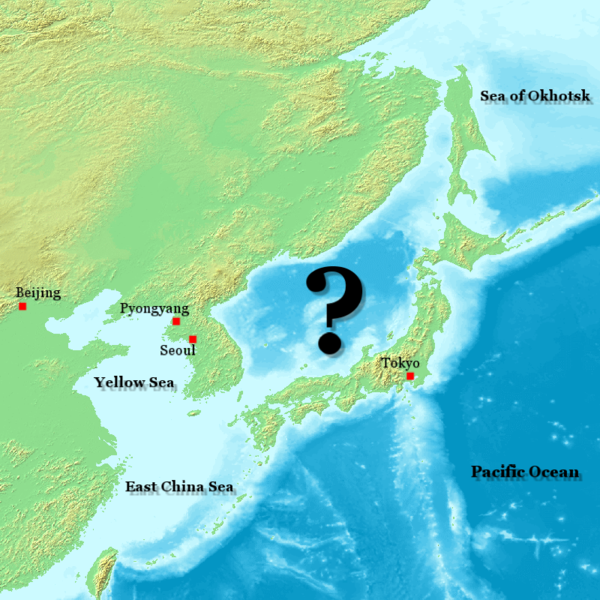
600px-Sea_of_Japan_naming_disputeRecently certain Korean American groups have begun lobbying for state legislation requiring public school textbooks to explain that the “Sea of Japan” is also called the “East Sea.” Japan prefers and uses the former, while South Korea the latter. Bills on this issue are currently at varying stages of adoption in Virginia, New Jersey, and New York, and are part of a broader campaign to raise public awareness about Japan’s colonial and wartime behavior. In this post, I want to address briefly the constitutionality of this legislation under the doctrine of foreign affairs preemption. My view is that the legislation is likely permissible and not preempted.

I’ll begin with the key features of foreign affairs preemption. In American Insurance Association v. Garamendi, the Supreme Court explained that the constitutionality of a state action carrying more than “incidental” foreign policy consequences hinges on whether the action conflicts with federal foreign policy. In the presence of a clear conflict, the state law is invalid. Absent such a conflict, constitutionality depends primarily on the strength of the state interest at stake, as judged “by standards of traditional practice.” This means that non-conflicting state action is likely to be permissible if it falls within a traditional competence of state governments.

Addressing the doctrine’s requirements in order, there’s reason to believe that the foreign policy consequences of the textbooks legislation are more than incidental. Japan has already raised diplomatic protests and, according to some reports, threatened to withdraw business from the states involved. It’s hard to specify the precise point at which these kinds of repercussions become more than incidental, and it’s doubtful that Japan would damage its own business interests over a controversy of this nature, but the Supreme Court’s most famous case on foreign affairs preemption—Zschernig v. Miller—found that an Oregon inheritance statute had more than incidental consequences because it raised diplomatic complications with communist states. Those complications are loosely similar to what’s happening here.

The next question, then, is whether there’s a clear conflict between the recent legislation and federal policy. Arriving at an answer is difficult because, somewhat bizarrely, there are conflicting accounts of the Obama Administration’s policy. According to Reid Wilson of the Washington Post, spokeswoman Jen Psaki explained that policy as follows on February 4th at the State Department’s daily press briefing:

“The State Department does not get involved in state and local government discussions on text books. The U.S. Government uses names decided by the U.S. Board on Geographic Names. The U.S. Board on Geographic Names’ standard name for that body of water is the Sea of Japan. We understand that the Republic of Korea uses a different term. Per U.S. policy, we use only one name to refer to all high seas features. This is a long-standing U.S. policy that we apply all around the globe.”

If this quote is accurate, it seems fairly obvious that there is no conflict preemption. While the U.S. Government has a policy of using only the name “Sea of Japan,” the Administration has no policy on whether the fifty states must themselves use that name, at least in textbooks. As Ms. Psaki reportedly explained, the State Department “does not get involved” in that issue. If there were a conflict, we would see the State Department oppose state usage of the name “East Sea.”

But there is serious reason to question the accuracy of Wilson’s account. Not a single source on the Internet corroborates it. According to a transcript on the State Department’s own website, what Ms. Psaki actually said was simply that “the U.S. Government uses names decided by the U.S. Board on Geographic Names. The U.S. Board on Geographic Names’ standard name for that body of water is the Sea of Japan. We understand that the Republic of Korea and others use a different term, but that is the term we use.” This is quite different; notably absent is the earlier quote’s language on how the State Department doesn’t get involved in disputes about the content of public school textbooks. And the difference seems material: The quote on the Department’s website is a somewhat stronger basis for conflict preemption because it confirms that the federal government has a policy of using only the name “Sea of Japan,” and it doesn’t show the State Department expressly disavowing a position on the content of the textbooks. Is Ms. Psaki implicitly conveying that the states should follow the federal lead? Not certain, but also not absurd to think yes. More clarification would be helpful.

In any event, let’s assume there’s no clear conflict between the state legislation and federal policy. This would mean that Virginia, New Jersey, and New York could require the use of the name “East Sea” in their public school textbooks if doing so falls within the “traditional competence” of state governments. Framing becomes really important at this point. If one characterizes the legislation as a matter of public education, it plainly falls within traditional state competence and implicates important state interests in setting course curricula. If one thinks of the legislation as an effort to take a position on a delicate matter of international geopolitics, state competence disappears entirely.

It’s a little hard to predict what a court would do here, but I think the better argument is that the legislation is permissible (again, assuming no conflict). Two reasons: First, there’s no way for states to avoid angering either Japan or Korea, given the zero-sum nature of the dispute. Korea would probably be upset if New York, for example, abandoned its bill, while Japan would be upset if the bill passed. Neither result is a good one, but they’re roughly equivalent insofar as the United States is allies with both countries. Textbooks could drop any reference to the disputed body of water, but it’s not clear that doing so would appease either side, and that solution would suggest that public education must skip over sensitive topics in world politics and history due to potentially adverse diplomatic complications. That can’t be right.

Second, there’s a sense in which the simple existence of foreign affairs preemption as a doctrine makes the exercise of foreign affairs preemption unnecessary. This is so because the doctrine’s limitations signal to other countries that the federal government lacks power to block certain forms of state action even when there are extraterritorial consequences. By sending this signal, the doctrine confines political responsibility to the acting state and discourages foreign governments from retaliating against the nation as a whole. Any well-informed foreign government like Japan’s will understand as much and likely retaliate–if at all–only against the acting state, which will diminish any resulting harm to national interests and in turn significantly reduce, if not eliminate, the need for federal preemption.

Posted in Foreign Affairs Constitution, Uncategorized | Tagged , , | Leave a comment